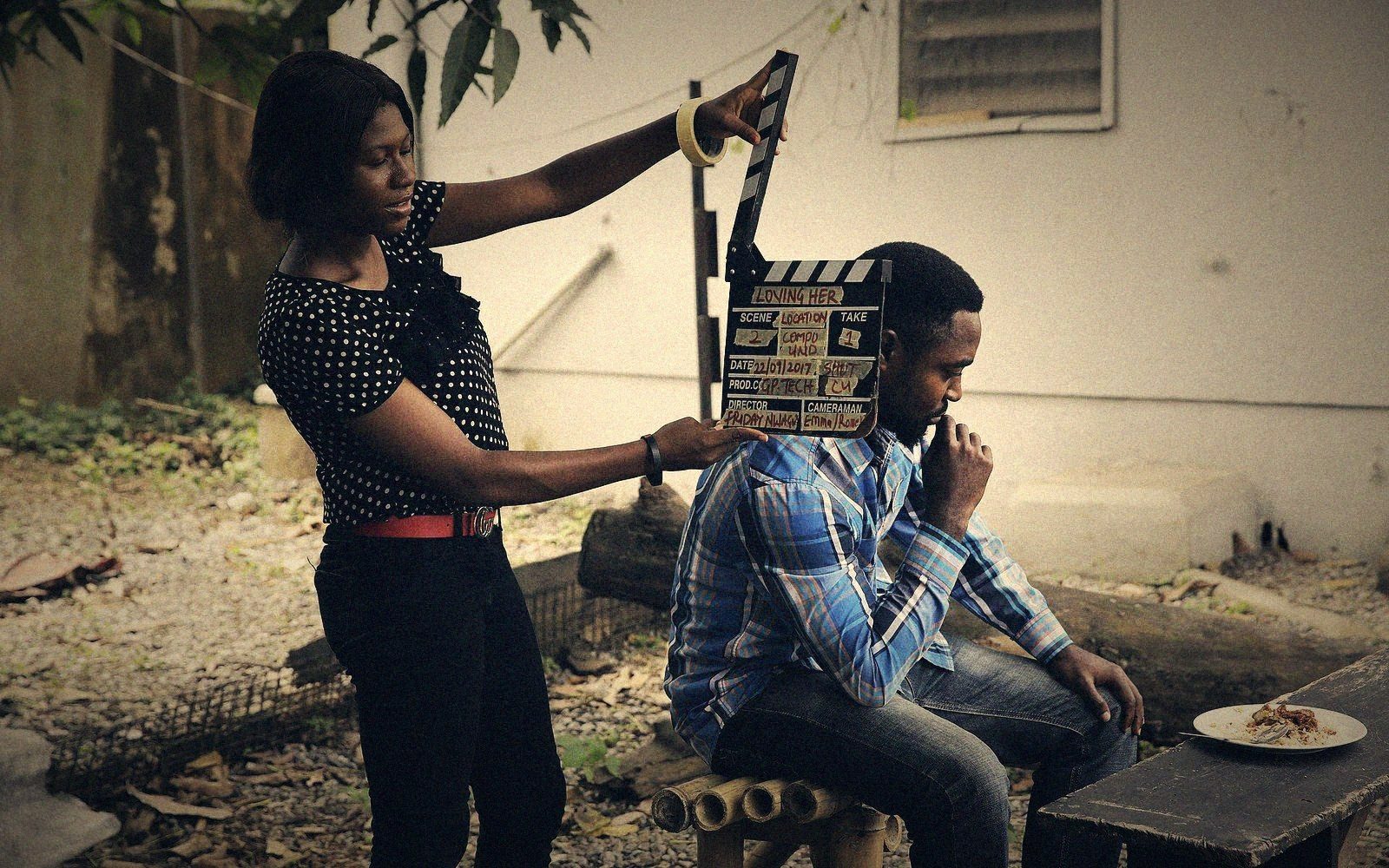
The system and its purpose
Continuity editing is a set of conventions so thoroughly absorbed by mainstream cinema that most viewers could not name a single rule they are obeying. Match on action — cut mid-movement so the eye follows the gesture across the edit. The one-eighty rule — keep the camera on one side of an axis between two characters so their eyelines, over-shoulders, and close-ups stay spatially coherent. The eyeline match — when someone looks off-screen, the next cut shows us what they are looking at, oriented correctly. These rules are not laws of nature. They are an industrial grammar developed across the silent era and codified by the studio system, and their sole function is to make three-dimensional space feel stable inside a two-dimensional frame. Do it right and the viewer never once wonders where anything is. The invisible edit, as editors call it, is invisible because spatial logic is quietly maintained beneath it.
Which is why a violation is so loud. Cross the line in a conversation scene between two people who are supposed to face each other, and suddenly they seem to face the same direction — they become parallel, not opposed, and the room folds in on itself. Break a match on action badly and the body appears to stutter, the movement looping or lurching. These are failures, and they read as failures, because the system they breach is the only thing giving the shot sequence its claim on real space.
When breaking it is the argument
But there is a second category: the deliberate violation, where the spatial disorientation is the point. Godard did this so programmatically in À bout de souffle (1960) that the jump cut — an edit between two shots so similar in angle and subject that continuity cannot be maintained — became a signature of the French New Wave and a statement about what cinema owed to realism. The jump cuts in that film are abrasive. They are supposed to be. The viewer is jolted out of absorption and reminded that a film is being assembled by someone with opinions.
The rules exist so the audience never thinks about space. Breaking them makes them think about space, which is occasionally the point.
Less celebrated, but equally instructive, is the use of axis breaks in films about psychological disorientation. In Polanski's Rosemary's Baby (1968), the apartment's geography is presented carefully — until the sequences where Rosemary's grip on her own experience loosens, at which point spatial coherence loosens with it. You cannot always reconstruct where the camera is relative to the room. That is not accident and it is not incompetence; it is the visual argument for a woman who can no longer trust what her senses tell her. The domestic thriller uses architectural space as a psychological instrument, and breaking continuity is one of the tools.
Even a match on action can be weaponised. Kubrick cuts from the bone thrown in the air to the orbital satellite in 2001: A Space Odyssey (1968) — one of the most famous match cuts in the medium — because matching the shape across a gulf of time is itself the statement. The visual rule is followed in order to make the concept land: a match cut that spans four million years is only possible because the rule is legible enough to collapse the distance.
The rules, briefly named
- Match on action
- cutting mid-movement so the eye tracks the gesture across the edit
- 180-degree rule
- keeping the camera on one side of the axis between subjects to preserve their spatial relationship
- Eyeline match
- cutting from a look to what is being looked at, oriented to feel correct
- Jump cut
- an edit between similar angles and subjects that produces visible discontinuity; originally a "failure," later a style
The cost of knowing the rule
What this demands of a filmmaker is precision about cause and effect. Breaking continuity costs audience comfort, and that cost should purchase something — spatial unease, temporal rupture, the sense that the character's world is folding. A violation without payoff reads as an error even when it is intentional, because the viewer has no frame inside the film for understanding it as a choice. The rule is the only context the break has.
This is also why close reading matters here. When you notice a spatial inconsistency — a room that does not quite add up, an eyeline that goes wrong — the first question is not "did they make a mistake?" but "does this feel like it has a cost?" Earned disorientation charges the space. Accidental disorientation just leaks.