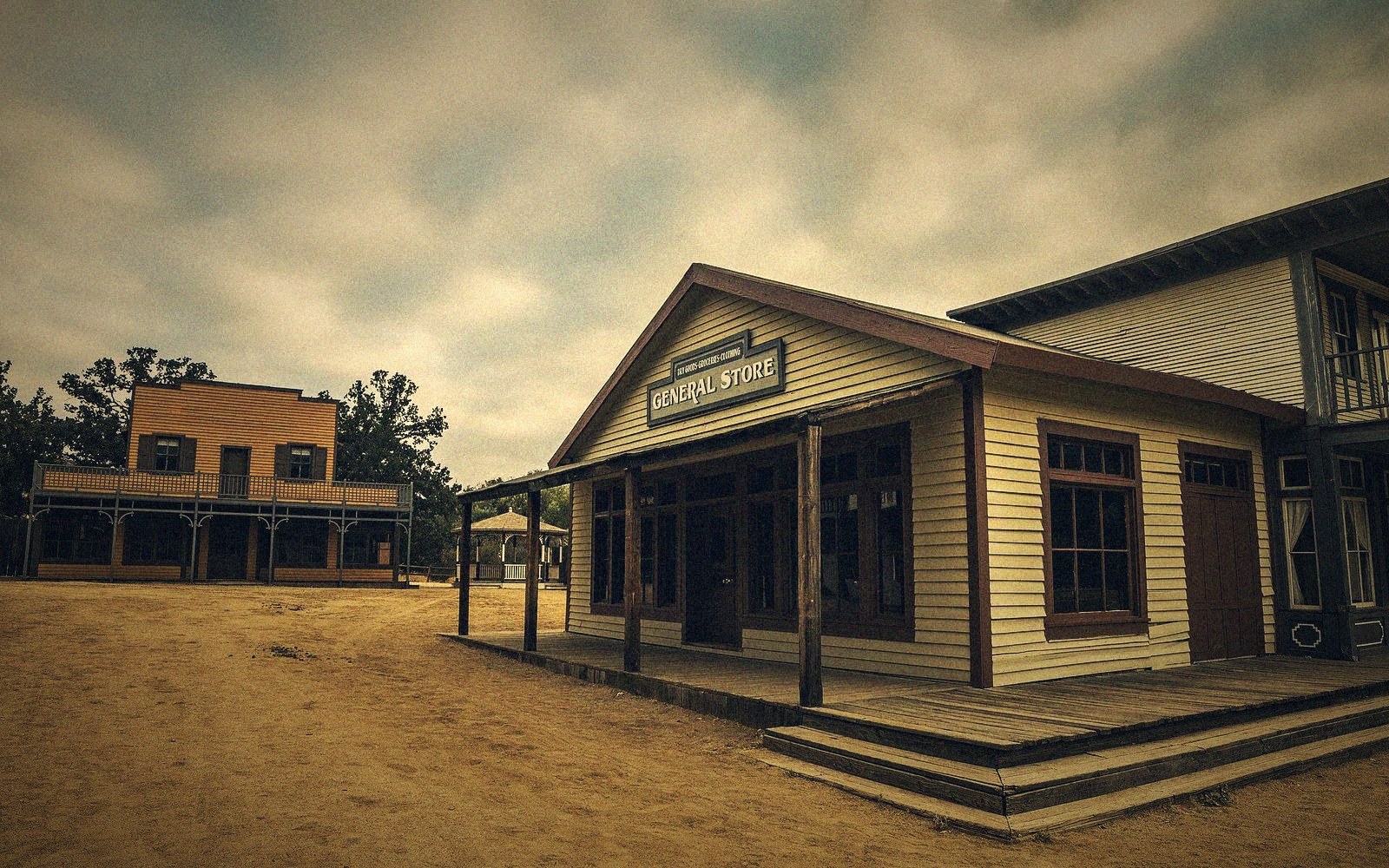
The boundary that drives everything
Strip a western down and you find the same structural engine running underneath: a line that divides the settled from the unsettled, the law from its absence. The town is on one side — its church, its hotel, its sheriff's star. The wilderness is on the other. And the genre's whole dramatic energy comes from things and people crossing that line, from both directions.
The hero almost always lives on the wrong side of it. He rides in from the desert; he will ride back out again. Shane arrives from nowhere, solves the problem of the open range, and disappears back into the mountains. Ethan Edwards in The Searchers crosses the threshold at the opening and cannot finally enter the house at the close — Ford frames it from inside the doorway, so the wilderness is literally the picture's border, and Ethan stands in it, belonging nowhere. That doorway shot is not decoration. It is the argument of the film made visible.
The western deals in this geometry with unusual explicitness because the American frontier gave it a historical alibi. Frederick Jackson Turner declared the frontier closed in 1893; Hollywood spent the following century dramatising its disappearance in real time. Late westerns in particular — The Wild Bunch, McCabe and Mrs. Miller, Unforgiven — are elegies for the man who no longer fits either side of the line, arriving too late or too damaged to cross it in the right direction. Peckinpah's gang is not defeated by the law; it is defeated by the fact that the law has become indistinguishable from professional violence on the other side of the border. The line is still there. It just no longer runs where morality used to be.
Every one is about a boundary: settlement and wilderness, law and its absence.
How the genre uses space to make the argument
The visual grammar of the western is inseparable from its ideological one. Landscape is not backdrop; it is pressure. When the camera pulls wide in Monument Valley you are not watching scenery — you are watching the smallness of human order against geological time, and registering how provisional the town really is. The wide shot earns its keep. The same logic governs interior space: a saloon, a jail, a one-street town are all enclosures fighting the open horizon visible through every window and door.
Blocking in the genre is almost always about threshold — who stands in the doorway, who sits indoors, who is caught in the street between the two. The gunfight at high noon is structurally a crossing: both men walk toward each other across the line, and only one walks back. What the showdown stages is not just violence but a verdict on which side of settlement the story will come down. Gary Cooper at the end of High Noon throws his tin star in the dirt — a gesture that says the line itself has been exposed as inadequate, that the town didn't deserve to be saved.
The genre also uses sound to manage that threshold. Silence is wilderness. Noise — hammering, a piano, voices — is settlement. When a town goes quiet before a gunfight, you are hearing the civilised world temporarily revert to the other side. Sound carries meaning at the cut long before any image confirms the threat.
This is why the western never quite dies. It is not a historical curiosity about a particular century of American expansion; it is a durable machine for staging the question of what any ordered society owes to the violent force that built it. Every contemporary story about a lone operative outside legal oversight, every neo-noir about a cop who breaks the rules to enforce them, every thriller set in a lawless borderland is borrowing the western's structural grammar without acknowledgement. The line between settlement and wilderness relocates — to a city precinct, a cartel border, a post-apocalyptic wasteland — but the dramatic engine is the same. The genre persists because the question it asks has never been answered satisfactorily on either side.
Key structural terms
- Threshold
- the doorway, the town limit, the crossing point; the western's central dramatic unit
- The wide shot
- landscape framing that makes settlement look provisional against open terrain
- The showdown
- a staged crossing: both men enter no-man's-land; only one returns to the settled side
- Elegy western
- late-period work (The Wild Bunch, Unforgiven) that mourns the disappearance of the line itself